

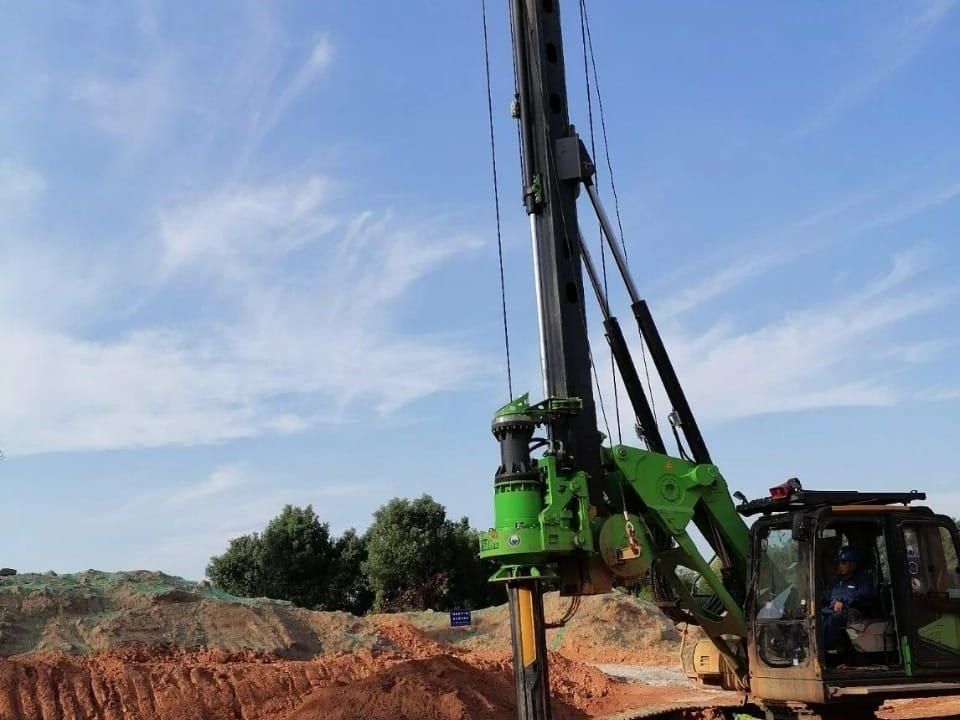
Piling
Bored Cast In-situ Piles
Large-diameter bored piles, cast in place, for high-rise buildings, bridges and heavily loaded structures.
Diameter: 750–2000 mm
Overview
Bored cast in-situ piles are formed by drilling a large-diameter hole with a rotary piling rig, lowering a steel reinforcement cage into it and filling it with concrete on site. They are the usual deep foundation for heavily loaded buildings and structures.
Where the ground is loose or below the water table, the borehole is kept stable with temporary steel casing, a drilling support fluid, or both. Concrete is then placed through a tremie pipe from the base upwards, which displaces the fluid and gives a continuous, sound pile shaft.
Because each pile is drilled rather than driven, there is far less noise and vibration than with driven piling, and the soil brought up during boring confirms the ground conditions at every pile position.
Typical applications
- High-rise residential and commercial buildings
- Bridges, flyovers and other infrastructure
- Industrial plants and heavily loaded warehouses
- Structures with large column loads or high lateral loads
- Sites with deep soft ground over rock
- Foundations where vibration from driving would be a problem
Our process
Review the site and design
We study the site investigation and structural drawings and agree the piling method, borehole support and testing requirements.
Set out and install casing
Each pile position is set out and a temporary casing is installed at the top of the borehole to guide the rig and protect the ground.
Bore to founding level
The rotary rig bores to the design depth, with casing or support fluid keeping the hole stable, and the founding stratum is checked.
Clean the base and place the cage
The base of the borehole is cleaned and the reinforcement cage is lifted and lowered into position.
Concrete by tremie
Concrete is placed through a tremie pipe from the base upwards in one continuous pour, and the temporary casing is withdrawn.
Test and hand over
Piles are recorded and tested as specified by the design engineer, then handed over for pile caps.
Photo gallery
Related projects
Frequently asked questions
What sizes of bored piles do you install?
We install bored cast in-situ piles from 750 mm up to 2000 mm in diameter.
What is the difference between bored piles and driven piles?
Bored piles are drilled and cast in place, so they produce little vibration and can be made very large. Driven piles are precast units hammered or pushed into the ground, which is fast but noisier and better suited to open sites.
How is the borehole kept from collapsing?
Depending on the ground, the borehole is supported with temporary steel casing, a drilling support fluid, or both. Concrete is then placed by tremie pipe from the bottom up so the pile shaft forms without soil falling in.
What do you need from us to prepare a quote?
The site location, structural drawings with pile sizes and depths, and the site investigation report if one is available. If you do not have all of these yet, contact us and we will advise on the next steps.