

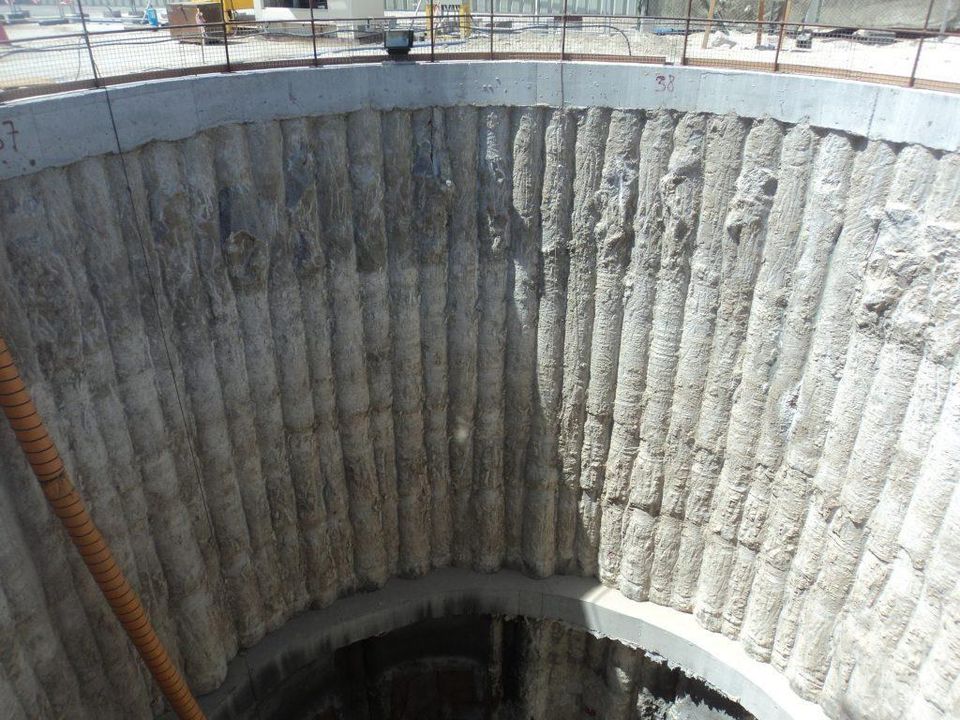
Earth retention / Shoring
Secant Piles
Overlapping, interlocking bored piles that form a continuous wall holding back both soil and groundwater.
Overview
A secant pile wall is made of bored piles that overlap one another. Primary piles are installed first with a gap between them; secondary piles are then bored between them, cutting into the sides of the primary piles so the two interlock into a continuous wall.
Because there are no gaps, a secant wall retains groundwater as well as soil. That makes it the usual choice for basements and shafts below the water table, and for excavations where drawing down the groundwater could affect neighbouring buildings.
A concrete guide wall is typically built first to hold every pile in the right position, and the piles are tied together at the top with a capping beam. The wall can work as temporary support during excavation or as the permanent basement wall.
Typical applications
- Basements below the water table
- Shafts, pump stations and underground tanks
- Deep excavations next to existing buildings
- Excavations close to rivers, lakes and the coast
- Permanent retaining walls
Our process
Review the design
We review the wall layout, the excavation depth, the groundwater level and the pile arrangement with the design engineer.
Build the guide wall
A concrete guide wall is cast along the wall line to position each pile accurately.
Install the primary piles
Primary piles are bored and concreted at spacings that leave room for the secondary piles.
Install the secondary piles
Secondary piles are bored between the primaries, cutting into them so the wall interlocks, then reinforced and concreted.
Cast the capping beam and excavate
A capping beam ties the wall together, and excavation proceeds in stages with propping or anchors as designed.
Photo gallery
Related projects
Frequently asked questions
What is a secant pile wall?
It is a retaining wall made of bored piles that overlap and interlock, forming a continuous wall that holds back both soil and groundwater.
When should I choose a secant wall instead of a contiguous wall?
Choose a secant wall when the excavation goes below the groundwater level, or when lowering the groundwater could affect nearby buildings. Where groundwater is not a problem, a contiguous wall is usually more economical.
What do "hard" and "soft" piles mean in a secant wall?
They describe the strength of the concrete in the primary piles. Softer primary piles are easier to cut into when the secondary piles are bored; harder primaries are used where the whole wall must carry load permanently.