

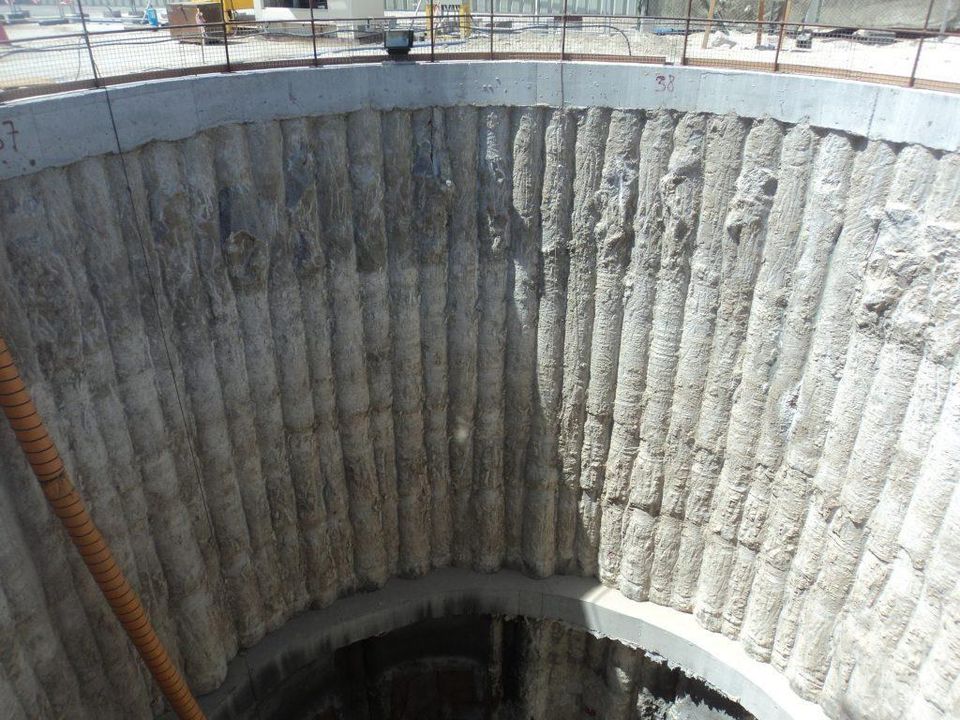
Earth retention / Shoring
Contiguous Piles
Rows of closely spaced bored piles that form a retaining wall for basements and deep excavations.
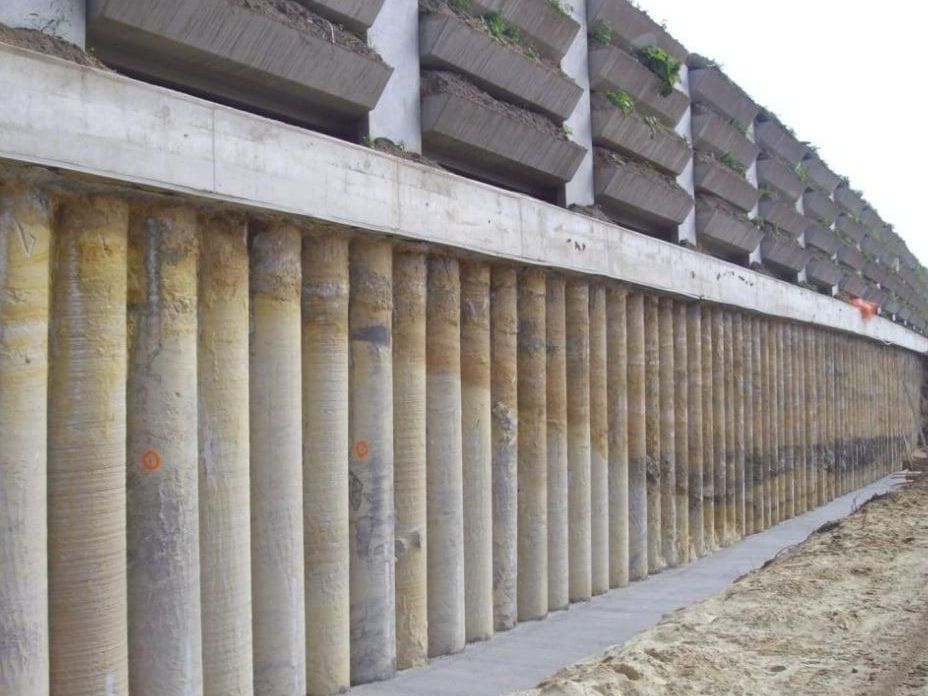
Overview
A contiguous pile wall is a line of bored piles installed close together, with a small gap between neighbouring piles. Once the piles are tied together at the top with a reinforced concrete capping beam, they act as a retaining wall that lets the ground in front be excavated safely.
The wall is built before excavation starts, so the surrounding ground, roads and neighbouring buildings are supported throughout the work. As the excavation goes deeper, the wall can be propped or anchored if the design requires it.
Because there are small gaps between the piles, a contiguous wall is not watertight. It is most economical where the groundwater level is below the excavation, or where any seepage can be controlled, for example with grouting or a sprayed concrete facing.
Typical applications
- Basements for residential and commercial buildings
- Underground car parks
- Excavations next to roads, boundaries and existing buildings
- Retaining walls on cut slopes
- Permanent walls that are faced or lined after excavation
Our process
Review the design
We review the wall design, the excavation depth and the groundwater conditions with the design engineer.
Set out the wall line
The line of the wall and each pile position are set out accurately on site.
Bore and concrete the piles
Each pile is bored, reinforced and concreted in sequence along the wall line.
Cast the capping beam
The pile heads are trimmed and a reinforced concrete capping beam is cast to tie the wall together.
Excavate in stages
Excavation proceeds in stages, with props or anchors installed where the design requires them.
Photo gallery
Related projects
Frequently asked questions
What is a contiguous pile wall?
It is a row of closely spaced bored piles, tied together with a concrete capping beam, that retains the ground so an excavation such as a basement can be dug safely beside it.
What is the difference between contiguous and secant pile walls?
In a contiguous wall there are small gaps between the piles, so it is not watertight. In a secant wall the piles overlap and interlock, forming a continuous wall that holds back groundwater.
Is a contiguous pile wall permanent or temporary?
It can be either. Many contiguous walls become the permanent basement wall once a facing or lining is added; others only support the excavation during construction.