

Earth retention / Shoring
H-Iron Timber Shoring
Steel H-beams with timber lagging — a quick, economical way to support excavations during construction.
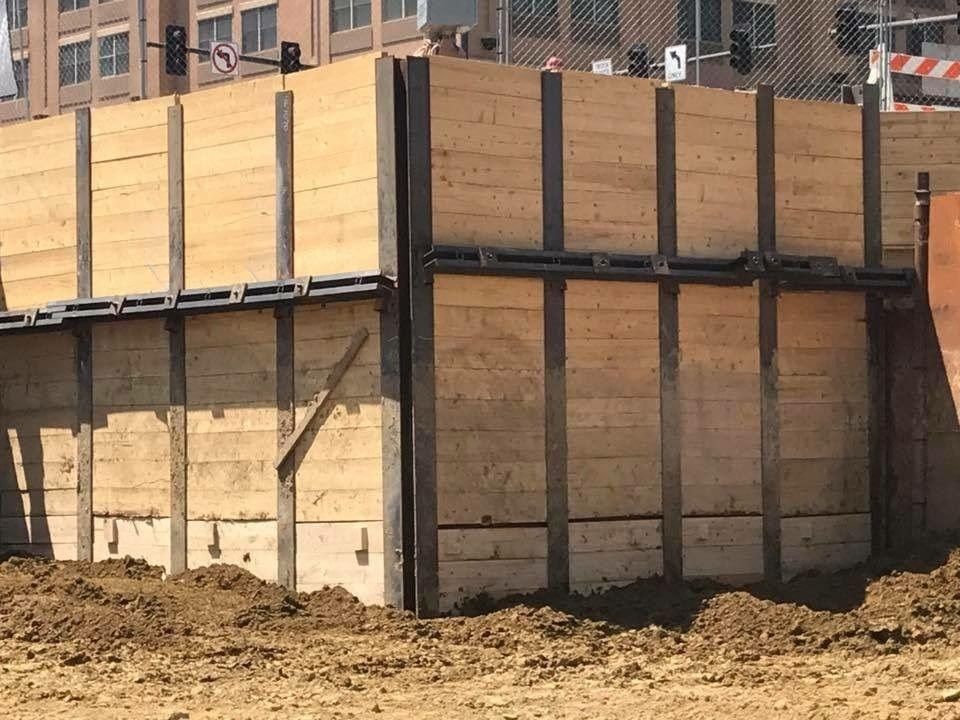
Overview
H-iron timber shoring, also known as soldier pile and lagging, is a temporary retaining system. Steel H-section beams are installed vertically at regular intervals along the edge of the planned excavation before digging begins.
As the excavation goes down, timber boards are slotted between the flanges of neighbouring beams to hold back the soil. Depending on the depth and the loads, the beams are supported with steel walers and struts across the excavation, or with raking props.
The system is quick to install, uses reusable materials and is economical for temporary support. It is not watertight, so it works best where the groundwater level is below the excavation or can be controlled.
Typical applications
- Basement and foundation excavations
- Excavations beside roads and site boundaries
- Trenches for drainage, pipelines and services
- Temporary support during underground construction
Our process
Plan the shoring
We review the excavation depth, the ground and groundwater conditions and the surrounding structures, and agree the shoring layout.
Install the H-beams
Steel H-beams are installed along the excavation edge at the design spacing and depth.
Excavate and fit lagging
The ground is excavated in stages and timber lagging is fitted between the beams as each stage is exposed.
Install walers and struts
Walers, struts or props are installed at the design levels as the excavation deepens.
Remove and recover
Once the permanent structure can support the ground, the shoring is removed in sequence and the materials are recovered.
Photo gallery
Frequently asked questions
What is H-iron timber shoring?
It is a temporary retaining system of steel H-beams installed at intervals along an excavation, with timber boards fitted between them to hold back the soil as the excavation goes down.
When is H-iron timber shoring a good choice?
It is a quick and economical choice for temporary excavation support where the groundwater level is below the excavation or can be controlled. Where groundwater must be held back, sheet piles or a secant wall are usually better.
Is the shoring removed after construction?
Usually, yes. Once the basement or foundation structure can support the ground, the timber and H-beams are removed in sequence and can be reused.